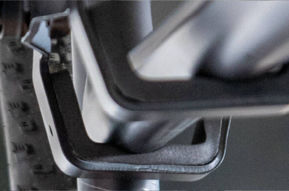
The tool features an integrated guide that securely bolts it to the crank spindle. The tool is then connected to the locking nut's toothing via a rotating mechanism. When the nut is loosened, the now-tightened tool can exert high pressure. This is achieved not least by the toothing used. This toothing has a wider, larger toothing than previously used. This ensures that the positive-lock connection can transmit all required torques at all times.